How to estimate a renovation job: the six-step process that protects your profit

I've priced renovation work since 2014, and the estimates that went wrong almost never failed on the math. They failed on the walkthrough I rushed, the quantity I eyeballed instead of measured, or the surprise behind the drywall that nobody priced. Estimating a renovation job well is a repeatable process, and every step in it exists because skipping that step once cost somebody real money.
This is the process I actually use: walk the job properly, turn the measurements into a material takeoff, price labor from crew-days, add overhead and profit on purpose, carry a contingency you can defend, and present a number the client can say yes to while they're still excited. None of it is complicated. All of it is skippable, which is exactly why so many renovation estimates lose money.
Step 1: Walk the job like you'll be the one building it
New construction starts from a clean set of drawings. A renovation starts from a house that has opinions. The walkthrough is where you find them, and the quality of everything downstream, the takeoff, the labor plan, the contingency, is set right here. Take the time. Measure every room you'll touch, and photograph everything, including the things you think you'll remember.
Talk scope with the client while you're standing in the space, not later by text. What stays, what goes, what finish level they're imagining, and what they've budgeted. A client who wants a mid-range bathroom and a client who wants a magazine bathroom are two different jobs in the same room, and it's cheaper to find that out now than after you've priced the wrong one.
- Measurements: room dimensions and ceiling heights, openings, runs of wall you'll touch, and anything you'll order against, like cabinet walls or stair openings.
- Condition notes: subfloor feel underfoot, panel capacity, plumbing age and material, signs of water, and anything that hints at what's behind the finishes.
- Logistics: parking, stairs and corners that limit what you can carry in, where the dumpster goes, and whether the client is living in the house during the work.
Step 2: Turn the measurements into a material takeoff
A material takeoff is the full list of what the job needs, in real quantities, priced. It's the difference between an estimate and a guess. Work through the scope surface by surface: things you count (doors, fixtures, outlets), things you measure by length (baseboard, pipe, wire), things you measure by area (flooring, drywall, paint, tile), and things you measure by volume (concrete, gravel).
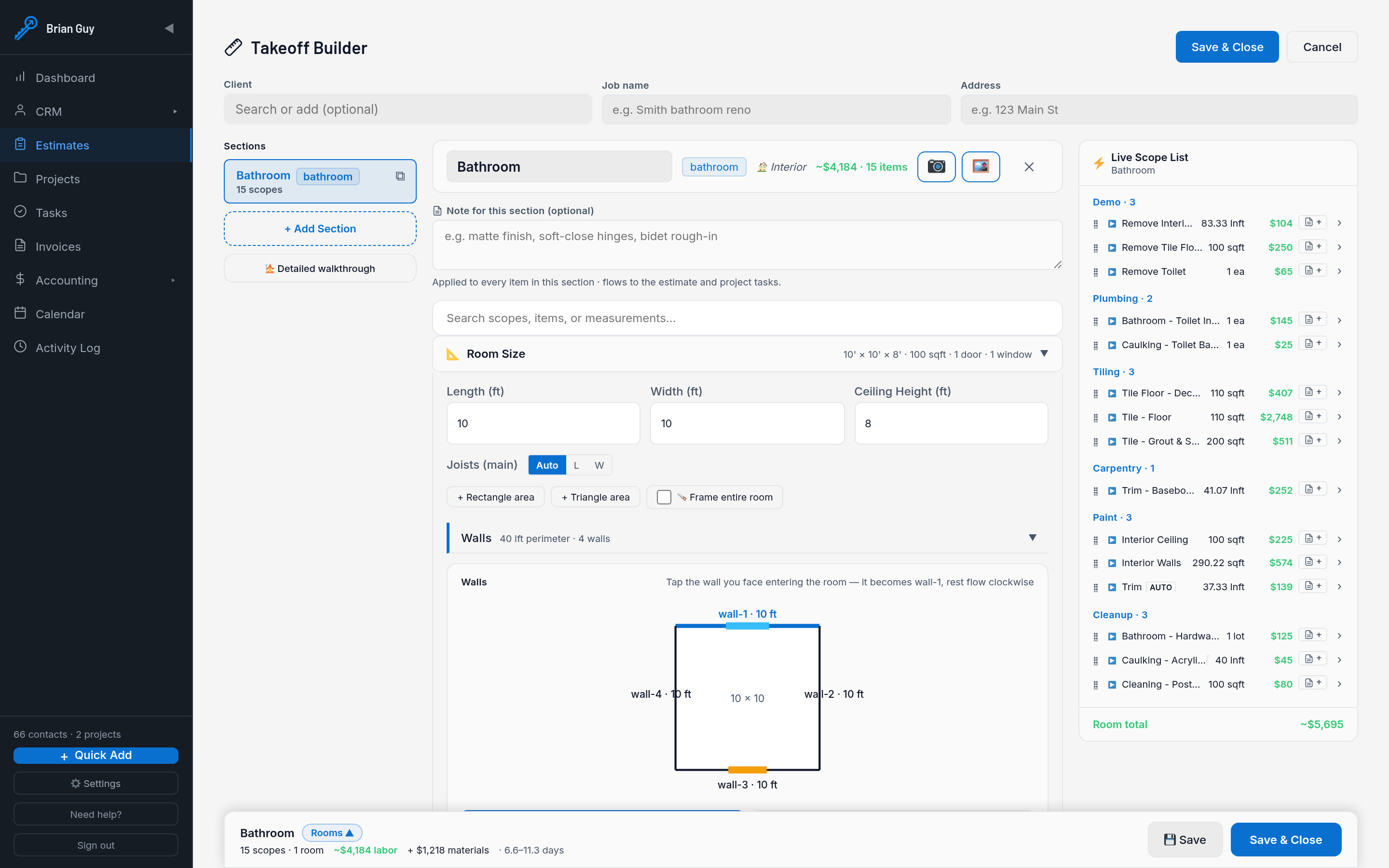
Add a waste factor before you price, not after you run short. Ten percent is a sane default for flooring and tile, more for diagonal layouts and small rooms with lots of cuts. If you want to sanity-check quantities fast, the free construction calculators on this site handle the common ones, like the flooring calculator, the paint calculator, and the concrete calculator. And this step is exactly what the Takeoff Builder automates: the dimensions you capture during the walkthrough drive formula-based quantities that land in a priced estimate, so the takeoff math happens once instead of every time the scope moves.
Step 3: Price labor from crew-days, not gut feel
Labor is where renovation estimates quietly die, because hours are easier to be optimistic about than material counts. Break the scope into tasks, put hours against each task, and multiply by a loaded rate that includes wages, payroll costs, and the unproductive time that's real on every job. Then ask the only question that keeps a schedule honest: how many crew-days is this, with how many people, and does that line up with the timeline you're about to promise?
Renovation labor carries a tax that new construction doesn't: demolition, discovery, and working around a client's life. Tying into old framing takes longer than framing new. Your best defense is your own history. If you track job costing on every job, your past jobs become a labor database that's more honest than your memory.
Step 4: Add overhead and profit on purpose
Materials plus labor is not your price. It's your cost. Overhead, the truck, the insurance, the software, the hours you spend quoting, is a real cost that every job has to carry a share of, and profit is what's left after all of it, not a synonym for your own wages. Price jobs as if you had to pay someone else to swing the hammer, because the day you grow, you will.
And know the difference between markup and margin before you set the number. A 20 percent markup is not a 20 percent margin, and contractors who mix them up under-price every job by the gap. The math is short and worth ten minutes: markup vs margin for contractors.
Step 5: Carry a contingency you can defend
On renovation work, something you can't see right now will cost money later. That's not pessimism, it's the category. A contingency of 10 to 15 percent on the riskier parts of the scope, older houses and wet areas at the top of the list, prices that reality instead of donating it. Show it as its own line and tell the client what it's for. In my experience an honest line builds more trust than a padded price hiding the same number.
Be clear about what contingency is not: it's not a budget for scope changes. When the client upgrades the tile or adds a pot light, that's new work, and it gets a written change order against the approved scope, priced before it's built. Here's how to write a change order that actually gets paid.
Step 6: Present it fast, in writing, and get the yes on record
Speed wins renovation work, especially referral work. The homeowner is most sold on you in the hours after the walkthrough, and an estimate that arrives the next morning beats a slightly sharper one that arrives next week. Send a line-item estimate with the scope spelled out, the exclusions named, and payment terms stated. Here's what to include in a detailed contractor quote, and a free estimate template if you want the bones laid out.
Then get the approval somewhere you can find it in August. A thumbs-up text is not a record. In Stairkey the client approves the estimate in their own portal and the yes lands on the job itself, next to the scope it approved, which is exactly where you want it the day a change order conversation starts.
The loop that makes your next estimate better
The last step happens after the job: compare what you estimated to what the job actually cost, line by line. Every gap is a correction to next quote's numbers, and after a dozen jobs the corrections compound into estimates you can defend in your sleep. That feedback loop is the real answer to how experienced contractors price so quickly. They're not guessing faster, they're reusing better data.
If the process above sounds like a lot of spreadsheet work, that's because done by hand, it is. Walkthrough to takeoff to priced estimate to approval to invoice is the exact path construction estimating software exists to collapse, and you can see the whole flow in the walkthrough-to-signed-estimate guide.